Wednesday, July 7, 2021

A Novena of Our Lady of Mount Carmel


  There is no true Catholic who does not know that the intercession of the Most Holy Virgin Mary is a most powerful method of obtaining benefits and favours from the Majesty of God; since, as this Holy Queen is really and truly the Mother of God, Her dear Son will not deny Her any thing which She asks of Him. For this reason, Christian piety has discovered many ways of honouring this dear Lady, so that by Her powerful intercession She may obtain for us help in our necessities, consolation in our afflictions, and the fulfilment of any just desires. And the faithful, experiencing the power of Her intercession with God in the graces they constantly receive through Her, recognise Her as their Mother, and as such venerate and love Her. But above all, the Carmelites and those who wear the Holy Scapular ought to love this Blessed Virgin, for She enriched them with this singular privilege, so that by it they might be known and distinguished as Her children, and particularly under Her protection; confirming this favour by continual and great prodigies and miracles, which have been and still are experienced. And so that they may shew their love and gratitude towards this great Queen and most loving Mother, as also to implore Her especial assistance to obtain what they desire, this Novena has been written, in which Her most extraordinary favours are commemorated, and which is to be performed according to the following directions.


Directions for performing this Novena.

1.) The first thing to be remarked is, that this Novena may be made at any time of the year, either on nine consecutive days or on nine consecutive Saturdays (this day being chosen as consecrated to the Mother of God); but the proper time for performing it is in the month of July, beginning it on the eighth of July, and ending it on the sixteenth day of that month, which is the Feast of the Blessed Virgin of Mount Carmel; or beginning it on the fifteenth--that is, on the eve of the Feast,--and concluding it on the twenty-third, which is the last day of the Octave.

2.) The second is, that this Novena may be said in the person's own house before an image or picture of our Lady of Mount Carmel; but the best place to say it in is the church, before an altar of the Blessed Virgin, if there be one, or if not, a picture or medal may be used. And the Novena is to be said kneeling, if illness or any other just cause does not prevent.

3.) The third is, that the person who makes the Novena is to confess and communicate on the first day of the Novena if possible, or at least on some day during the course of it; and that, in order to be better prepared to recite this Novena, they are to make very devoutly the acts of faith, hope, charity, and contrition, as contained in the first prayer, in order to purify the soul to praise God and the Holy Virgin: for if a soul full of failings and imperfections were to offer to God and our Lady prayers and praises, it would be like presenting delicious viands in an unclean vessel, so that they could not be eaten; and it would also be well to confess and communicate on the last day of the Novena.

4.) The fourth is, that on the first day of the Novena, the person who performs it is to determine for what end or intention he wishes to make it,--that is, what he desires to obtain from God by the intercession of His Holy Mother; and he is to ask it with great humility and entire resignation to the will of God, only desiring it if it be for the greater glory of His Divine Majesty and good of his own soul; and also he is to be disposed, if he does not obtain what he asks, to be as satisfied as if God had granted his desire, preferring the Divine will and pleasure to his own.

5.) The fifth remark is, that any person who cannot read or hear the Novena read, can make it by saying every day five Salve Reginas and five Ave Marias, saying first an act of contrition, and observing as far as possible the directions here given.

6.) The sixth and last is, that the person who makes the Novena ought to offer to God and the Blessed Virgin some act of virtue every day during the Novena: as giving alms, hearing Mass, a short time of mental prayer, frequent acts of faith, hope, charity, and contrition, as also of conformity with the holy will of God. And he ought to have great confidence, through the intercession of the Holy Virgin, that he will obtain from the Majesty of God what he asks in this Novena, if it be for the good of his soul.--pages 3 - 7


Saturday, July 3, 2021

Litany on Behalf of Our Country


CatholicHarborOfFaithAndMorals.com


This Litany is a timely Catholic prayer we should say often, imploring God's mercy for the conversion of our country.


Lord, have mercy on us.
Christ, have mercy on us.
God the Father of heaven, have mercy on us.
God the Son, Redeemer of the world, have mercy on us.
God the Holy Ghost, have mercy on us.
Holy Trinity, one God, have mercy on us.

O God, who hast been pleased to magnify Thy name amongst our ancestors, and to distinguish them by the particular marks of their piety, continue the same mercy to us, we beseech Thee: that now, in these days, we may seek Thee with all our hearts, and zealously labour to copy the examples which our forefathers have left us. Amen.

For this end, we most humbly implore Thy goodness to have compassion on this our country, and by Thy powerful grace to remove from it whatever is provoking or displeasing to Thee.

Have mercy, O God, on this nation. And be Thou its powerful deliverer.

From infidelity and profaneness,
Deliver us, O Lord. *

From all irreligion, and contempt of Thy sacred mysteries, *

From all presumption, and the abuse of Thy holy word, *

From all heresies  *

From gluttony and drunkenness, *

From the profanation of Thy holy name, in cursing and swearing, *

From all kinds of prodigality and sensuality, *

From frauds, and all kinds of oppression and injustice, *

From the spirit of faction, of malice, hatred, and every kind of uncharitableness, *

O God, Thou hast been a Father to this nation, and replenished it with many blessings. --Forsake it not now, we beseech Thee, and give it not up to a reprobate sense.

Bless this people, O Lord, and be Thou their inheritance.--And sanctify us, and make us a holy nation.

Give to all its inhabitants, O Lord, the spirit of the gospel.
Hear us, O Lord. **

Give to them a zeal for unity, peace, and truth. **

Grant that they may all seek the things that are above, and walk by the spirit of Christ. **

Grant that all who are in error may, by thy heavenly light, be led into Thy truth. **

Grant that all sinners may be truly converted, and, forsaking their evil ways, return to thee their God. **

Grant that all scandals may be removed. **

Grant that the pastors may become the light of the world. **

Grant that all magistrates may administer justice. **

Grant that all of the wealthier ranks may esteem virtue their greatest honour, and be ashamed of vice. **

Grant that the youth of both sexes may be withheld from all evil ways, and that they may dedicate their lives to virtue, piety, and religion. **

Grant that all obstinacy and blindness may be removed from the hearts of this people, and that, being reformed according to Thy blessed will, they may serve Thee in holiness and truth. **

Hear us, O Lord, now calling on thee.--And, through the infinite merits of thy only Son, grant our petitions.


Let Us Pray

O Almighty and everlasting God, who hast forsaken many Christian nations, and, in punishment of their sins, hast suffered them to be overrun by error and infidelity; grant, we beseech thee, that the rigour of these Thy judgments may strike us with a timely fear, and that, in earnest forsaking our evil ways, we may find mercy with Thee, through Jesus Christ our Lord. Amen.

Remember, we beseech Thee, Thy ancient mercies, and for the sake of so many holy servants, who have been faithful to thee, shew now compassion to us, and let Thy former mercies be renewed in us.--Hear us, O Lord, and in Thy mercy grant our petition.

Give ear to us, O God, here assembled before Thee, humbly prostrate in the confession of our unworthiness, and wholly confiding in Thy goodness and mercy.--Hear, likewise, O God, all those Thy Saints who, in this country, have faithfully served Thee, and are now happy with Thee in heaven.

Hear them praying for their country, and let their intercession prevail, through the merits of thy only Son, through which alone All prayers, whether on earth or in heaven, can find acceptance with Thee. Amen.

Let Us Pray

O God, by whose mercy the world subsisteth, and to whose power every nation of the earth is subject, have mercy on this nation, we beseech Thee, and, according to its necessities, which are all known to Thee, so pour forth Thy blessings on it that, by the help of Thy grace, it may in all things be well-pleasing in Thy sight; through Jesus Christ, our Lord. Amen.

Patriotic Virtue


Thursday, July 1, 2021

The Most Precious Blood of Jesus


Treatise 120 on John

A suggestive word was made use of by the Evangelist, in not saying: he pierced His side; or: he wounded; or anything like that, but: he opened; that therein might, as it were, be thrown open the door of life, from which have flowed forth the sacraments of the Church, without which there is no entrance into life that is truly life. The blood that was shed, was shed for the remission of sins. That water makes up the health-giving cup; and gives at the same time a bath and a draught. This was announced beforehand, when Noe was commanded to make a door in the side of the ark, through which the animals, not destined to perish in the flood, might enter, and by which the Church was prefigured. Because of this, the first woman was made from the side of the man while he slept, and she was called Life and Mother of the living. For the name signified a great good, before the great evil of her sin. This second Adam bowed His heads fell asleep on the cross, in order that from there a spouse might be formed for Him from that which He shed from His side as He slept. O death whereby the dead are raised anew to life! What is purer than this blood? What more health-giving this wound?

Men who were held in slavery under the devil served the devil and served the demons; but they have been redeemed from captivity. For they could sell themselves, but they could not redeem themselves. The Redeemer came, and paid the price; He shed His blood, and bought the world. Do you ask what He bought? See what He gave, and you will find out what He bought. The blood of Christ is the price. What is it worth? What, but the whole world? What, but all nations. Very ungrateful for their price or very proud, are they who say that the price is of such small worth as to buy only the Africans; or that they are so great, that it was given for them alone. Therefore let them not rejoice or be proud. What He gave, He gave for the whole world.

He had His blood, by which He redeemed us; and to this end He took blood, that He might shed it in order to redeem us. If you wish it, the blood of your Lord was given for you; if you do not wish it, it was not given for you. For perhaps you will say: My God had blood, with which He redeemed me, but now since He has suffered, He has given it all; what has remained to Him, that He may also give for me? This is a great thing, because He gave once, and He gave for all. The blood of Christ is salvation to him who wishes it, punishment to him who does not wish it. Why, therefore, do you hesitate to be set free from the second death, you who do not wish to die? By this you are set free, if you are willing to take up your cross, and follow the Lord; for He took up His cross and looked for His servant.


Litany of the Most Precious Blood

Lord, have mercy on us.
Christ have mercy on us.
Lord, have mercy on us.
Christ hear us.
Christ, graciously hear us.


Most Precious Blood of Jesus Christ,
Wash us O Saving Blood. *

Blood of the New Testament, *
Price of our redemption, *
Fountain of divine grace, *
Source of eternal life, *
Reparation for our sins, *
Pledge of everlasting happiness, *
Oblation of divine justice, *
Key of heaven, *
Purification of our souls, *
Deliverance from sin, *
Healing balm for our wounds, *
Remission of our sins, *
Infinite ransom paid for our debts, *
Life-giving fountain, *
Hope of the poor, *
Solace of the afflicted, *
Support of the weak, *
Remedy for the sick, *
Reconciliation of sinners, *
Joy of the just, *
Refuge of all Christians, *
Admiration of Angels, *
Consolation of Patriarchs, *
Desire of Prophets, *
Strength of Apostles, *
Hope of Martyrs, *
Justification of Confessors, *
Sanctification of Virgins, *
Crown of the Blessed, *

Be merciful,
Spare us, O Lord.
Be merciful,
Graciously hear us, O Lord.


From all evil,
Lord Jesus, deliver us. **

From all injustice, **
From all pride and vanity, **
From all envy and ill-will, **
From all uncleanness and gluttony, **
From all anger and hatred, **
From all sloth, **
From eternal damnation, **
Through Thy Most Precious Blood, **
Through the Precious Blood Thou didst shed in Thy Circumcision, **
Through the Precious Blood Thou didst shed on Mount Olivet, **
Through the Precious Blood Thou didst shed under the maltreatment of Thy enemies, **
Through the Precious Blood Thou didst shed at Thy scourging, **
Through the Precious Blood Thou didst shed at the crowning with thorns, **
Through the Precious Blood Thou didst shed on Thy road to Calvary, **
Through the Precious Blood Thou didst shed when Thou wert stripped of Thy clothes, **
Through the most Precious Blood Thou didst shed when Thy Sacred Heart was pierced, **
Through the Precious Blood Thou didst give to Thy Disciples at Thy last Supper, **
Through the same Precious Blood which is still daily consecrated at the holy Sacrifice of the Mass, **


We poor sinners,
Beseech Thee, hear us.
That Thou wouldst spare us,
We beseech Thee, hear us. ***

That Thou wouldst pardon us, ***
That Thou wouldst grant us true piety, ***
That Thou wouldst fill our hearts with gratitude and love, ***
That Thou wouldst fill our hearts with a holy fear, ***
That Thou wouldst give us true repentance for our sins, ***
That through Thy Precious Blood Thou mayest assist us in our last agony, ***
That through the same Precious Blood Thou mayest grant us a happy death, ***
That through it Thou mayest save us from Purgatory, ***
That through it Thou mayest redeem the poor souls from their sufferings, ***
That through it Thou mayest show mercy to all, ***


Lamb of God, Who takest away the sins of the world:
Spare us, O Lord.
Lamb of God, Who takest away the sins of the world:
Graciously hear us, O Lord.
Lamb of God, Who takest away the sins of the world:
Have mercy on us.

Christ hear us.
Christ, graciously here us.
Lord have mercy.
Christ have mercy.
Lord have mercy.

Our Father (secretly). Hail, Mary (secretly).

V. Jesus Christ has loved us.
R. And through His Precious Blood washed us from our sins
V. Assist Thy servants, O Lord.
R. Whom Thou hast redeemed by Thy Precious Blood.


Let us pray:

Most merciful Redeemer, through the price of Thy Precious Blood, and through the merits of Thy bitter passion and death: grant that we may make ourselves worthy to enter that happiness which Thou didst purchase for us. Amen.

Wednesday, June 30, 2021

Bergoglio Calls Saint Paul "Rigid", "Traditionalist"

 BERGOGLIO PROFANANDO LA CATEDRAL DE BUENOS AIRES ARGENTINA MISA TANGO


en.news “Like Paul we are called to be free from the hypocrisies of the external, to be free from a religious observance that makes us rigid and inflexible, free from ambiguous links with power [sic!], and the fear of being misunderstood and attacked,” Francis said in his Saints Peter and Paul homily (June 29).

He loves to oppose form and content - as if they could be separated. Probably due to a certain senile rigidity, Francis went again on his rigidity trip insisting that Saint “Paul was freed from the religious zeal that made him fierce in upholding the traditions he had received.” In Catholic spirituality "religious zeal" is considered a virtue.

For Francis , "the formal observation of religion and the sword wielding of defence of Tradition" made Saint Paul "rigid." He is right, and as a matter of fact, Saint Paul admonishes the Thessalonians to "stand firm and hold to the traditions which you were taught by us, either by word of mouth or by letter” (2 Thess. 2:15).


Monday, June 28, 2021

The apostate Jorge Mario Bergoglio Praises Homosex Activist And His apostate “Ministry”

 ― Aristotle: “The tyrant surrounds himself with bad people because he likes to be flattered and no man of high spirit will flatter him.”  


en.news Francis sent a handwritten June 21 letter to the homosex activist James Martin, 60, who posted it on Twitter.com.


Martin is alleged to be a "Jesuit." The letter is the first written papal endorsement of a priest’s homosex engagement. Francis congratulated Martin on a recent homosex conference and thanked him for an alleged “pastoral zeal” and for Martin's “ability to be close to people” [rather: close to sin].

Francis doesn't shy away from blasphemy by claiming that Martin’s approach emulates the “closeness that Jesus had” and “reflects the closeness of God.” He speaks of the active homosexuals in Martin’s "flock" as "children of God" while in reality, the God of the Bible “hates” and “punishes” them with fire.

According to Francis, God’s “style” has three elements: closeness, compassion and tenderness - none of them are hallmarks of Francis' Vatican tyranny.

Martin is based in New York. He has never admitted of being a practicing homosexual but on social media the homosex subculture is also called “James Martin Lifestyle community.”


 As Father Paul Kramer said: “The antipope and his apostate collaborators will be as sister Lucy said, supporters of the devil, those who work for evil without being afraid of anything.”


Related:


Bergoglio backs up his accomplice of heresy


Apostasy: Bergoglio supports an Argentine old friend, gay activist nun, who inaugurated apartments for transvestite men with their homosexual partners and called them 'girls'


But even if we or an angel [messenger] from heaven should proclaim to you a gospel contrary to what we proclaimed to you, let that one be accursed! Galatians 1:8


Friday, June 25, 2021

On the Feast of Corpus Christi, the Apostate Jorge Bergoglio Turns the “Bread of Angels” Into “Bread of UNREPENTANT SINNERS”

The apostate Jorge Mario Bergoglio in his eagerness to install the abomination of desolation continues to promote the Eucharistic sacrilege. The Bible describes the doctrine of Jezebel which is part of the doctrine of demons. 


Leonardo Boff: "Pope Francis is much more liberal than what is supposed" "A couple of months ago, for instance, he expressly approved that a homosexual couple adopt a child. 

Revelation 2:20

 But I have this against you: you tolerate that woman Jezebel, who calls herself a prophet and is teaching and beguiling my servants to practice fornication and to eat food sacrificed to idols.


On Corpus Christi Sunday, Bergoglio again refused to kneel

For Pope Francis, the Holy Eucharist Is the “Bread of Sinners,” for Saint Thomas Aquinas, It Is “Panis Angelorum”

For Pope Francis, the Holy Eucharist Is the “Bread of Sinners,” for Saint Thomas Aquinas, It Is “Panis Angelorum”

For Pope Francis, the Holy Eucharist Is the “Bread of Sinners,” for Saint Thomas Aquinas, It Is “Panis Angelorum”

Corpus Christi is the grand and solemn liturgical feast in praise of the Blessed Sacrament. Inspired by Saint Juliana of Mont Cornillon (1193–1258), it originated in the Middle Ages. Pope Urban IV approved it with the Bull Transiturus of September 8, 1264, and asked Saint Thomas Aquinas to compose its liturgical office.

Hence, we owe to Saint Thomas’s theological genius (he was also an inspired poet) the beautiful hymn Lauda Sion, that is part of the new feast’s Mass. In its verses, we find the beautiful expression “Ecce panis angelorum” (behold the Bread of angels), which came to be used frequently to designate Holy Communion. That is easy to understand because one can receive it only in the state of grace, which renders men similar to angels.

On the Feast of Corpus Christi, Pope Francis Turns the “Bread of Angels” Into “Bread of Sinners”

Pope Francis took advantage of the commemoration of the Feast of Corpus Christi on June 6 to change the meaning of the Sacrament of the Eucharist into one entirely contrary to the Church’s perennial teaching. Thus, changing the poetic but theologically safe formulation of Saint Thomas, he transforms the designation “Bread of Angels” into “Bread of sinners.”

As he had done on another occasion,1 at the Angelus on that feast day, Pope Francis presented Judas, the traitor, as an example of divine mercy. He said that, at the Holy Supper, Jesus knew of Judas’s betrayal. And “what does Jesus do? He reacts to the evil with a greater good. He responds to Judas’s ‘no’ with the ‘yes’ of mercy. He does not punish the sinner but rather gives His life for him.”2

Pope Francis adds, “When we receive the Eucharist, Jesus does the same with us: he knows us; he knows we are sinners; and he knows we make many mistakes, but he does not give up on joining his life to ours.”

Concluding his thought, he says that Jesus “knows that we need it, because the Eucharist is not the reward of saints, no, it is the Bread of sinners. This is why he exhorts us: ‘Do not be afraid! Take and eat.’”

A Doctrine Contrary to the Council of Trent

The above words and the example of Judas when designating the Eucharist as “bread of sinners” make one wonder if Pope Francis suggests that the proper effect of Holy Communion is to forgive mortal sins, not just venial ones. That would run counter the Council of Trent: “Can. 5. If anyone says that the special fruit of the Most Holy Eucharist is the remission of sins, or that from it no other fruits are produced: let him be anathema.”3

Another error equally opposed to that Council and the Scriptures, and seemingly insinuated in Pope Francis’s words, is that being in the state of grace is not required to receive Holy Communion. However, quoting Saint Paul, the Council of Trent says:

[A]ssuredly, the more the holiness and divinity of this heavenly sacrament are understood by a Christian, the more diligently ought he to give heed that he approaches not to receive it but with great reverence and holiness, especially as we read in the Apostle those words full of terror: He that eat and drink unworthily, eat and drink judgment to himself (1 Cor. 11:29). Wherefore, he who would communicate ought to recall to mind the precept of the Apostle: Let a man prove himself.4

The moralists Antonio Lanza and Pietro Palazzini explain, “[by] divine right, all who are in mortal sin cannot licitly approach Communion.”5

Effects of the Sacrament of the Eucharist

These moral theologians summarize the effects of Eucharistic Communion as follows: “The specific effects of Holy Communion are: a) uniting us with Jesus Christ and His Mystical Body, the Church, in a more intimate way; b) increasing sanctifying grace in us; c) nurturing and fortify our spiritual life; d) weakening concupiscence; e) giving us a sign of eternal life. The effects will be all the more abundant the better are the dispositions [with which one receives It].”6

Holy Communion can indirectly erase a mortal sin when a person, unaware that he is in sin, receives Communion piously. In these cases, “theologians incline to the opinion, that in such exceptional cases the Holy Eucharist can restore the soul to the state of grace.”7

Communion in Amoris Laetitia

Given Pope Francis’s new designation of the Holy Eucharist as the “bread of sinners,” one understands better why, in his Apostolic Exhortation Amoris Laetitia, he opened in a footnote the possibility for people living in adultery to receive Holy Communion.8

In that Apostolic Exhortation, he says that a person can be in an “objective situation of sin” but still “living in God’s grace, can love and can also grow in the life of grace and charity, while receiving the Church’s help to this end.” In a note, he states, “In certain cases, this can include the help of the sacraments” because the Holy Eucharist “is not a prize for the perfect, but a powerful medicine and nourishment for the weak.”9


The bishops of the Buenos Aires Pastoral Region made entirely clear what Amoris Laetitia said confusingly. They say that in certain cases when the first marriage cannot be the object of annulment, “Amoris Laetitia opens the possibility of access to the sacraments of Reconciliation and the Eucharist (see notes 336 & 351). In turn, these dispose the person to continue maturing and growing with the power of grace.”10

In his response to these bishops, Pope Francis praises their pronouncement and adds, “The writing is very good and makes fully explicit the meaning of chapter VIII of Amoris Laetitia. There are no other interpretations.”11

Pope Francis thus deems authentic the interpretation of the Argentine bishops, according to which married couples in adultery can receive sacramental absolution and Communion without abandoning their sinful situation. This is perfectly consistent with seeing the Holy Eucharist as the “bread of sinners.”

It is good to add that, according to the traditional doctrine sanctioned at the Council of Trent, a confession made without repentance and the firm purpose of abandoning sin is invalid and a profanation of the sacrament.12

Unanswered Dubia

On September 19, 2016, four cardinals of Holy Church—Carlo Caffarra, Joachim Meisner (both deceased), Raymond Burke, and Walter Brandmüller—addressed to Pope Francis a request for clarification in the form of dubia (doubts) on the new doctrines contained in Amoris Laetitia, especially on the Holy Eucharist and the Sacrament of Penance. They wrote:

It is asked whether, following the affirmations of Amoris Laetitia (300-305), it has now become possible to grant absolution in the sacrament of penance and thus to admit to Holy Communion a person who, while bound by a valid marital bond, lives together with a different person more uxorio without fulfilling the conditions provided for by Familiaris Consortio, 84, and subsequently reaffirmed by Reconciliatio et Paenitentia, 34, and Sacramentum Caritatis, 29. Can the expression “in certain cases” found in note 351 (305) of the exhortation Amoris Laetitia be applied to divorced persons who are in a new union and who continue to live more uxorio [as husband and wife]?13

To this day, almost five years later, Pope Francis has not responded to the dubia. His silence in this regard is now public and notorious throughout the Catholic world.

The following year, on July 16, 2017, a group of Catholic theologians and intellectuals published a document titled Correctio filialis de haeresibus propagatis. They showed the same concern as the cardinals. They wrote forcefully, “Several passages of Amoris Laetitia, in conjunction with acts, words, and omissions of Your Holiness, serve to propagate seven heretical propositions.”14

The Sacrament and Repentant Sinners

Is it not a blasphemy to call the Holy Eucharist “bread of sinners”? The sacraments bestow grace on those who receive them worthily. None of them can be given to an adult who is not in a condition to receive them. Even for Penance or Confession (currently called the Sacrament of Reconciliation), to produce its effects of restoring a sinner to the state of grace, he needs to seriously confess his sins with perfect or at least imperfect repentance (attrition) and a firm resolve to abandon sin.

According to Lanza-Palazzini, “Whoever consciously receives the Sacrament without the proper dispositions, commits a serious sin of sacrilege because it renders useless the rite that Christ instituted as an effective sign of grace.” They conclude: “The profanation of a very holy thing is a grave insult against the Divine Founder. Concretely, the state of grace is required to receive the Sacraments of the living;15 if that is missing, sacrilege is committed.”16

Abortion and Eucharist

Objectively, in the external forum, it is quite evident that not only those who procure and those who perform an abortion are in a state of sin. The legislators or judges who turn pro-abortion measures into law are as well. They commit at least the sin of scandal by denying, in practice, a doctrine always taught by the Church and based on natural law.
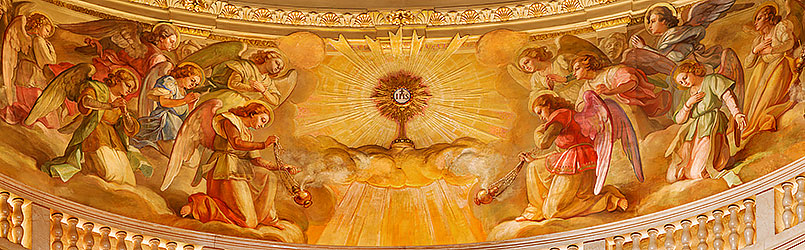
Angels’ Adoration of the Holy Eucharist, cupola fresco by Giuseppe Rollini (1889-1891) in the Basilica of Mary Help of Christians, Turin, Italy

Angels’ Adoration of the Holy Eucharist, cupola fresco by Giuseppe Rollini (1889-1891) in the Basilica of Mary Help of Christians, Turin, Italy.
Photo Credit: © Renáta Sedmáková – stock.adobe.com

Pope Francis’s singular teaching that the Holy Eucharist, the “Bread of Angels,” is the “bread of sinners” has serious practical consequences. No one can deny that he is at least silent on this matter regarding the dubia. Furthermore, instead of supporting courageous bishops who take Catholic doctrine seriously and publicly state how allowing such politicians to receive Holy Communion is incompatible with Catholic doctrine, Pope Francis consistently favors concessive prelates.

Ecce Panis Angelorum

Let us close with the verses of Saint Thomas Aquinas recited in the Sequence of the Mass of the Feast of Corpus Christi:

Behold the Bread of Angels,

For us pilgrims food, and token

Of the promise by Christ spoken,

Children’s meat, to dogs denied.

Shewn in Isaac’s dedication,

In the manna’s preparation:

In the Paschal immolation,

In old types pre-signified.

Jesu, shepherd of the sheep:

Thou thy flock in safety keep,

Living bread, thy life supply:

Strengthen us, or else we die,

Fill us with celestial grace.

Thou, who feeds us below:

Source of all we have or know:

Grant that with Thy Saints above,

Sitting at the feast of love,

We may see Thee face to face.

Amen. Alleluia.


Final Impenitence: The Evidence That Bergoglio Died at War with God and Left an Army Behind to Continue His Work

 From his private fear of hell to his final public directives: why his successors' obstinacy confirms that his war against doctrine rema...