Wednesday, July 28, 2021

Olympian Lifts Up Our Lady’s Miraculous Medal After Winning Gold Medal for the Philippines


@ABSCBNNews, Twitter / @hidilyndiaz, Instagram

by Jacqueline Burkepile - Jul 26, 2021

Churchpop.com

Congratulations to this talented Olympian! 👏 👏 👏 


Olympian Hidilyn Diaz won the first-ever gold medal for the Philippines on July 26, 2021 in the women’s 55 kg (121-pound) weightlifting category for the 2020 Tokyo Olympics. The Philippines have competed in the Olympics for the last 97 years.


The 30-year-old broke a world record after lifting a combined weight of 493.8 pounds!


” I cannot believe my name is in the Olympic record. So I’m really thankful,” Diaz said. “God is Amazing! God is Amazing!”


After winning, the four-time Olympian praised God and lifted up the Miraculous Medal she wore around her neck. 


Tuesday, July 27, 2021

3 Day Novena to Saint Martha


Novena Prayer to St. Martha


May the Blessed Virgin Mary, Mother of God, and all the Saints intercede with God for us. The Lord hath made His Saints wonderful. And heard them when they cried unto Him.

LET US PRAY

Preserve us, we beseech Thee, O Lord, from all dangers to soul and body, and by the intercession of the Blessed and Glorious Mary ever Virgin, Mother of God, of St. Joseph, the holy Apostles Peter and Paul, of St. Martha and all the Saints, in Thy mercy, grant us health and peace, that after all adversity and error is removed, Thy Church may serve Thee in freedom and safety, through the same Jesus Christ, Thy Son, Our Lord, Who liveth and reigneth with Thee in the union of the Holy Ghost world without end. Amen.


St. Martha pray for us.


(Our Father, Hail Mary, Glory, etc. 3 times)


Monday, July 26, 2021

Saint Anne, Grandmother of Jesus, Pray for us!


Saint Anne, Mother of the Blessed Virgin Mary


Uniting the blood of kings with that of pontiffs, the glory of Anne's illustrious origin is far surpassed by that of her offspring, without compare among the daughters of Eve. The noblest of all, who have ever conceived by virtue of the command to " increase and multiply," beholds the law of human generation pause before her as having arrived at its summit, at the threshold of God; for, from her fruit God himself is to come forth, the fatherless Son of the Blessed Virgin, and the grandson of Anne and Joachim. Before being favoured with the greatest blessing ever bestowed on an earthly union, the two holy grand-parents of the Word made Flesh had to pass through the purification of suffering. Traditions which, though mingled with details of less authenticity, have come down to us from the very beginning of Christianity, tell us of these noble spouses subjected to the trial of prolonged sterility, and on that account despised by their people; of Joachim cast out of the temple and going to hide his sorrow in the desert; of Anne left alone to mourn her widowhood and humiliation. For exquisite sentiment this narrative might be compared with the most beautiful histories in Holy Scripture.


"It was one of the great festival days of the Lord. In spite of extreme sorrow, Anne laid aside her mourning garments, and adorned her head and clothed herself with her nuptial robes. And about the ninth hour she went down to the garden to walk; seeing a laurel she sat down in its shade, and poured forth her prayer to the Lord God, saying: God of my fathers, bless me and hear my supplication, as thou didst bless Sara and didst give her a son!

And raising her eyes to heaven, she saw in the laurel a sparrow's nest, and sighing she said: Alas! of whom was I born to be thus a curse in Israel?

To whom shall I liken me? I cannot liken me to the birds of the air; for the birds are blessed by thee, O Lord.

To whom shall I liken me? I cannot liken me to the beasts of the earth: for they, too, are fruitful before thee.

To whom shall I liken me? I cannot liken me to the waters; for they are not barren in thy sight, and the rivers and the oceans full of fish praise thee in their heavings and in their peaceful flowing.

To whom shall I liken me? I cannot liken me even to the earth, for the earth, too, bears fruit in season, and praises thee, O Lord.

And behold an Angel of the Lord stood by, and said to her: Anne, God has heard thy prayer; "thou shalt conceive and bear a child, and thy fruit shall be honoured throughout the whole inhabited earth. And in due time Anne brought forth a daughter, and said: My soul is magnified this hour. And she called the child Mary; and giving her the breast, she intoned this canticle to the Lord:

I will sing the praise of the Lord my God: for He has visited me and has taken away my shame, and has given me a fruit of justice. Who shall declare to the sons of Ruben that Anne is become fruitful? Hear, hear, O ye twelve tribes: behold Anne is giving suck (Protevangelium Jacobi)!"


The feast of St. Joachim, which the Church celebrates on the Sunday within the octave of his blessed Daughter's Assumption, will give us an occasion of completing the account of these trials and joys in which he shared. Warned from heaven to leave the desert, he met his spouse at the golden gate which leads to the Temple on the east side.


Not far from here, near the Probatica piscina, where the little white lambs were washed before being offered in sacrifice, now stands the restored basilica of St. Anne, originally called St. Mary of the Nativity. Here, as in a peaceful paradise, the rod of Jesse produced that blessed branch which the Prophet hailed as about to bear the flower that had blossomed from eternity in the bosom of the Father. It is true that Sephoris, Anne's native city, and Nazareth, where Mary lived, dispute with the holy City the honour which ancient and constant tradition assigns to Jerusalem. But our homage will not be misdirected if we offer it today to Blessed Anne, in whom were wrought the prodigies, the very thought of which brings new joy to heaven, rage to Satan, and triumph to the world.

Anne was, as it were, the starting-point of Redemption, the horizon scanned by the prophets, the first span of the heavens to be empurpled with the rising fires of aurora; the blessed soil whose produce was so pure as to make the Angels believe that Eden had been restored to us. But in the midst of the aureola of incomparable peace that surrounds her, let us hail her as the land of victory surpassing the most famous fields of battle; as the sanctuary of the Immaculate Conception, where our humiliated race took up the combat begun before the throne of God by the Angelic hosts; where the serpent's head was crushed, and Michael, now surpassed in glory, gladly handed over to his sweet Queen, at the first moment of her existence, the command of the Lord's armies.

What human lips, unless touched like the prophet's with a burning coal, could tell the admiring wonder of the Angelic Powers, when the Blessed Trinity, passing from the burning Seraphim to the lowest of the nine choirs, bade them turn their fiery glances and contemplate the flower of sanctity blossoming in the bosom of Anne? The Psalmist had said of the glorious City whose foundations were now hidden in her that was once barren: The foundations thereof are in the holy mountains (Ps. lxxxvi. 1); and the heavenly hierarchies crowning the slopes of the eternal hills, beheld in her heights to them unknown and unattainable, summits approaching so near to God, that He was even then preparing His throne in her. Like Moses at the sight of the burning bush on Horeb, they were seized with a holy awe on recognizing the mountain of God in the midst of the desert of this world; and they understood that the affliction of Israel was soon to cease. Although shrouded by the cloud, Mary was already that blessed mountain whose base, i.e., the starting point of her graces, was set far above the summits where the highest created sanctities are perfected in glory and love.

How justly is the mother named Anne, which signifies grace, she in whom for nine months were centered the complacencies of the Most High, the ecstasy of the Angelic Spirits and the hope of all flesh! No doubt it was Mary, the daughter, and not the mother, whose sweetness so powerfully attracted the heavens to our lowly earth. But the perfume first scents the vessel which contains it, and even after it is removed, leaves it impregnated with its fragrance. Moreover, it is customary to prepare the vase itself with the greatest care; it must be all the purer, made of more precious material, and more richly adorned, according as the essence to be placed in it is rarer and more exquisite. Thus Magdalene enclosed her precious spikenard in alabaster. The Holy Spirit, the preparer of heavenly perfumes, would not be less careful than men. Now the task of blessed Anne was not limited, like that of a material vase, to passively containing the treasure of the world. She furnished the body of her who was to give flesh to the Son of God; she nourished her with her milk; she gave to her, who was inundated with floods of divine light, the first practical notions of life. In the education of her illustrious daughter, Anne played the part of a true mother: not only did she guide Mary's first steps, but she co-operated with the Holy Ghost in the education of her soul, and the preparation for her incomparable destiny; until, when the work had reached the highest development to which she could bring it, she, without a moment's hesitation or a thought of self, offered her tenderly loved child to him from whom she had received her.

Sic fingit tabernaculum Deo, thus she frames a tabernacle for God. Such was the inscription around the figure of St. Anne instructing Mary, which formed the device of the ancient guild of joiners and cabinetmakers; for they, looking upon the making of tabernacles wherein God may dwell in our churches as their most choice work, had taken St. Anne for their patroness and model. Happy were those times, when the simplicity of our fathers penetrated so deeply into the practical understanding of mysteries, which their infatuated sons glory in ignoring. The valiant woman is praised in the Book of Proverbs for her spinning, weaving, sewing, embroidering, and household cares: naturally then, those engaged in these occupations placed themselves under the protection of the spouse of Joachim. More than once, those suffering from the same trial which had inspired Anne's touching prayer beneath the sparrow's nest, experienced the power of her intercession in obtaining for others, as well as for herself, the blessing of the Lord God.

The East anticipated the West in the public cultus of the grandmother of the Messias. Towards the middle of the sixth century, a Church was dedicated to her in Constantinople. The Typicon of St. Sabbas makes a liturgical commemoration of her three times in the year: on the 9th September, together with her spouse St. Joachim, the day after the birthday of their glorious daughter; on the 9th December, whereon the Greeks, a day later than the Latins, keep the feast of our Lady's Immaculate Conception, under a title which more directly expresses St. Anne's share in the mystery; and lastly, the 25th July, not being occupied by the feast of St. James, which was kept on the 80th April, is called the Dormitio or precious death of St. Anne, mother of the most holy Mother of God: the very same expression which the Roman Martyrology adopted later.

Although Rome, with her usual reserve, did not until much later authorize the introduction into the Latin Churches of a liturgical feast of St. Anne, she nevertheless encouraged the piety of the faithful in this direction. So early as the time of Leo III. (795 - 816) and by that illustrious Pontiff's express command, the history of Anne and Joachim was represented on the sacred ornaments of the noblest basilicas in the Eternal City (Lib. pontif. in Leon. III). The Order of Carmel, so devout to St. Anne, powerfully contributed, by its fortunate migration into our countries, to the growing increase of her cultus. Moreover, this development was the natural outcome of the progress of devotion among the people to the Mother of God. The close relation between the two worships is noticed in a concession, whereby in 1381 Urban VI. satisfied the desires of the faithful in England by authorizing for that kingdom a feast of the blessed Anne. The Church of Apt in Provence had been already a century in possession of the feast; a fact due to the honour bestowed on that Church of having received almost together with the faith, the Saint's holy body, in the first age of Christianity.

Since our Lord, reigning in heaven, has willed that his blessed Mother should also be crowned there in her virginal body, the relics of Mary's mother have become doubly dear to the world, first, as in the case of others, on account of the holiness of her whose precious remains they are, and then above all others, on account of their close connection with the mystery of the Incarnation. The Church of Apt was so generous out of its abundance, that it would now be impossible to enumerate the sanctuaries which have obtained, either from this principal source or from elsewhere, more or less notable portions of these precious relics. We cannot omit to mention as one of these privileged places, the great Basilica of St. Paul outside the walls; St. Anne herself, in an apparition to St. Bridget of Sweden (Revelationes S. Birgittae. liv. VI., cap. 104), confirmed the authenticity of the arm which forms one of the most precious jewels in the rich treasury of that Church.

It was not until 1584 that Gregory XIII. ordered the celebration of this feast of 26th July throughout the whole Church, with the rite of a double. Leo XIII. in our own times (1879) raised it, together with that of St. Joachim, to the dignity of a solemnity of second class. But before that, Gregory XV., after having been cured of a serious illness by St. Anne, had ranked her feast among those of precept, with obligation of resting from servile work.

Now that St. Anne was receiving the homage due to her exalted dignity, she made haste to show her recognition of this more solemn tribute of praise. In the years 1623, 1624 and 1625, in the village of Keranna, near Auray, in Brittany, she appeared to Yves Nicolazic, and discovered to him an ancient statue buried in the field of Bocenno, which he tenanted. This discovery brought the people once more to the place, where, a thousand years before, the inhabitants of ancient Armorica had honoured that statue. Innumerable graces obtained on the spot spread its fame far beyond the limits of the province, whose faith, worthy of past ages, had merited the favour of the grandmother of the Messias; and St. Anne d'Auray was soon reckoned among the chief pilgrimages of the Christian world.

More fortunate than the wife of Elcana, who prefigured thee both in her trial and by her name, thou, O Anne, now singest the magnificent gifts of the Lord. Where is now the proud synagogue that despised thee? The descendants of the barren one are now without number; and all we, the brethren of Jesus, children, like Him, of thy daughter Mary, come joyfully, led by our Mother, to offer thee our praises. In the family circle the grandmother's feastday is the most, touching of all, when her grandchildren surround her with reverential love, as we gather around thee today.


St. Anne Grandmother of the baby Jesus

Many, alas! know not these beautiful feasts, where the blessing of the earthly paradise seems to revive in all its freshness; but the mercy of our God has provided a sweet compensation. He, the Most High God, willed to come so nigh to us, as to be one of us in the flesh; to know the relations and mutual dependences which are the law of our nature; the bonds of Adam, with which He had determined to draw us and in which He first bound Himself. For, in raising nature above itself, He did not eliminate it; He made grace take hold of it and lead it to heaven; so that, joined together on earth by their Divine Author, nature and grace were to be united for all eternity. We, then, being brethren by grace of Him Who is ever thy Grandson by nature, are, by this loving disposition of Divine Wisdom, quite at home under thy roof; and today's feast, so dear to the hearts of Jesus and Mary, is our own family feast.

Smile then, dear mother, upon our chants and bless our prayers. Today and always be propitious to the supplications which our land of sorrows sends up to thee. Be gracious to wives and mothers who confide to thee their holy desires and the secret of their sorrows. Keep up, where they still exist, the traditions of the Christian home. Over how many families has the baneful breath of this age passed, blighting all that is serious in life, weakening faith, leaving nothing but languor, weariness, frivolity, if not even worse, in the place of the true and solid joys of our fathers. How truly might the Wise Man say at the present day: "Who shall find a valiant woman?" She alone by her influence could counteract all these evils; but on condition of recognizing wherein her true strength lies: in humble household works done with her own hands; in hidden, self-sacrificing devotedness; in watchings by night; in hourly foresight; working in wool and flax, and with the spindle; all those strong things which win for her the confidence and praise of her husband; authority over all, abundance in the house, blessings from the poor whom she has helped, honour from strangers, reverence from her children; and for herself, in the fear of the Lord, nobility and dignity, beauty and strength, wisdom, sweetness and content, and calm assurance at the latter day (Cf. Prov. xxxi. 10-31).


Prayer:

O blessed Anne, rescue society, which is perishing for want of virtues like thine. The motherly kindnesses thou art ever more frequently bestowing upon us have increased the Church's confidence; deign to respond to the hopes she places in thee. Bless especially thy faithful Brittany; have pity on unhappy France, for which thou hast shown thy predilection, first, by so early confiding to it thy sacred body; later on, by choosing in it the spot whence thou wouldst manifest thyself to the world; and, again, quite recently entrusting to its sons the Church and seminary dedicated to thy honour in Jerusalem. O thou who lovest the Franks, who deignest still to look on fallen Gaul as the kingdom of Mary, continue to show it that love which is its most cherished tradition. Mayest thou become known throughout the whole world. As for us, who have long known thy power and experienced thy goodness, let us ever seek in thee, O mother, our rest, security, strength in every trial; for he who leans on thee has nothing to fear on earth, and he who rests in thy arms is safely carried.


_______________________


With my heart full of the most sincere venerations, I prostrate myself before thee, O glorious Saint Anne. Thou art that creature of privilege and predilection, who by thy extraordinary virtues and holiness didst merit from God the high favor of giving life to her who is the Treasury of all graces, blessed among women, the Mother of the Word Incarnate, the most holy Virgin Mary. By virtue of so lofty a privilege, do thou deign, O most compassionate saint, to receive me into the number of thy true clients, for so I profess myself and so I desire to remain throughout my entire life.

Shield me with thine effectual patronage and obtain for me from God the power to imitate those virtues where with thou wast so plentifully adorned. Grant that I may know and weep over my sins in bitterness of heart. Obtain for me the grace of most active love for Jesus and Mary, and resolution to fulfill the duties of my state of life with faithfulness and constancy. Save me from every danger that confronts me in life, and help me at the hour of death, that so I may come in safety to paradise, there to sing with thee, O most happy mother, the praises of the Word of God made Man in the womb of thy most pure daughter, the Virgin Mary. Amen.


Our Father, Hail Mary, Glory be, (three times).

(Indulgence of 300 days, once a day)

Bergoglio stubbornly denies and twists the Miracle of the Multiplication of Loaves and Fishes


Revelation 13:6
 It opened its mouth to utter blasphemies against God, blaspheming his name and his dwelling, that is, those who dwell in heaven.

Vanity and Power? Francis Insists On Denying Multiplication of Loaves

en.news Francis denied at the July 25 Angelus Christ’s multiplication of the loaves by turning the miracle into moralism.

He claimed, “It is interesting that in the accounts of the multiplication of the loaves in the Gospels, the verb ‘multiply’ never appears: no. On the contrary, the verbs used have the opposite meaning: ‘to break’, ‘to give’, ‘to distribute’. But the verb ‘to multiply’ is not used. The true miracle, says Jesus, is not the multiplication that produces vanity and power, but the sharing that increases love and allows God to perform wonders [which, according to Francis, do not take place].”

In reality, the Gospels state in their various reports that Christ took very few breads and fed thousands with them. Francis has denied this miracle already several times by stubbornly repeating the same wrong argument. 
Bergoglio is stubbornly denying the dogma of the divinity of Jesus Christ which is a clear sign of his Apostasy, Heresy and Schism. 


But what else is to be expected if for the apostate Jorge Bergoglio the Family "an essential component of food systems" 

Galatians 1:9
As we have said before, so now I repeat, if anyone proclaims to you a gospel contrary to what you received, let that one be accursed!

Bergoglio replaces the Liturgical Feast of Saint Anne with a ´Day for the elderly and grandparents´

Daniel 7:25

 He shall speak words against the Most High,

    shall wear out the holy ones of the Most High,

    and shall attempt to change the sacred seasons and the law;

and they shall be given into his power

    for a time, two times, and half a time.


Last year Bergoglio put the grandparents of Jesus in quotation marks on his Twitter account and this year instead of celebrating the Liturgical Feast of Saint Anne he replaced it with a ‘Day of the elderly and grandparents’. 


He even has plenty of time to celebrate the Olympics:


Let's not forget also that Bergoglio encourages pagan and idolatrous elders to pass on his pagan and false teachings to their future generation.


Apostate Jorge Mario Bergoglio:

"Those who are Christians with the Bible and those who are Muslims with the Koran, with the faith you have received from your fathers. 


Schismatic Marxist Paulo Suess: "Bergoglio is a practitioner of liberation theology"

Sunday, July 25, 2021

St James the Apostle, Pray for Us


Prayer to Saint James the Apostle
In this prayer to Saint James the Apostle, the faithful ask for the strength to fight the good fight, as James did, in order to be worthy followers of Christ.

O glorious Apostle, St. James, who by reason of thy fervent and generous heart wast chosen by Jesus to be a witness of His glory on Mount Tabor, and of His agony in Gethsemane;
Thou, whose very name is a symbol of warfare and victory: obtain for us strength and consolation in the unending warfare of this life, that, having constantly and generously followed Jesus, we may be victors in the strife and deserve to receive the victor's crown in heaven. 
Amen.


 (Can be used as a Novena for Nine Consecutive Days.)


O glorious Apostle, Saint James, who by reason of thy fervent and generous heart wast chosen by Jesus to be a witness of His glory on Mount Thabor, and of His agony in Gethsemane; thou, whose very name is a symbol of warfare and victory: obtain for us strength and consolation in the unending warfare of this life, that, having constantly and generously followed Jesus, we may be victors in the strife and deserve to receive the victor's crown in heaven. Amen.


(Our Father, Hail Mary, Glory be.)

(Indulgence of 300 days)


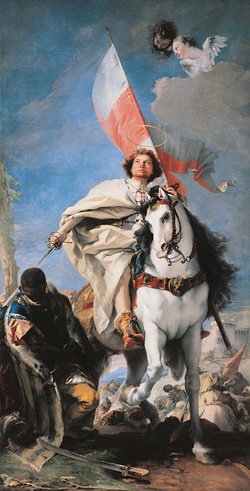
Saint James the Moor-slayer


Saint James the Greater, Apostle
from the Liturgical Year, 1909


Let us, today, hail the bright star, which once made Compostella so resplendent with its rays, that the obscure town became, like Jerusalem and Rome, a centre of attraction to the piety of the whole world. As long as the Christian empire lasted, the sepulchre of St. James the Great rivalled in glory that of St. Peter himself.

Among the Saints of God, there is not one who manifested more evidently how the elect keep up after death an interest in the works confided to them by our Lord. The life of St. James after his call to the Apostolate was but short; and the result of his labours in Spain, his allotted portion, appeared to be a failure. Scarcely had he, in his rapid course, taken possession of the land of Iberia, when, impatient to drink the chalice which would satisfy his continual desire to be close to his Lord, he opened by martyrdom the heavenward procession of the twelve, which was to be closed by the other son of Zebedee. O Salome, who didst give them both to the world, and didst present to Jesus their ambitious prayer, rejoice with a double joy: thou art not repulsed; He who made the hearts of mothers is thine abettor. Did he not, to the exclusion of all others except Simon his Vicar, choose thy two sons as witnesses of the greatest works of his power, admit them to the contemplation of his glory on Thabor, and confide to them his sorrow unto death in the garden of his agony? And to-day thy eldest born becomes the first-born in heaven of the sacred college; the protomartyr of the Apostles repays, as far as in him lies, the special love of Christ our Lord.

But how was he a messenger of the faith, since the sword of Herod Agrippa put such a speedy end to his mission? And how did he justify his name of son of thunder, since his voice was heard by a mere handful of disciples in a desert of infidelity? This new name, another special prerogative of the two brothers, was realized by John in his sublime writings, wherein as by lightning flashes he revealed to the world the deep things of God; it was the same in his case as in that of Simon, who having been called Peter by Christ, was also made by him the foundation of the Church: the name given by the Man-God was a prophecy, not an empty title. With regard to James too, then, Eternal Wisdom cannot have been mistaken. Let it not be thought that the sword of any Herod could frustrate the designs of the Most High upon the men of his choice. The life of the Saints is never cut short; their death, ever precious, is still more so when in the cause of God it seems to come before the time. It is then that with double reason we may say their works follow them; God, Himself, being bound in honour, both for His own sake and for theirs, to see that nothing is wanting to their plenitude. As a, victim, of a holocaust he hath received them, says the Holy Ghost, and in time there shall be respect had to them. The just shall shine, and shall run to and fro like sparks among the reeds. They shall judge nations, and rule over peoples; and their Lord shall reign for ever (Wisd. iii. 6-8). How literally was this Divine oracle to be fulfilled with regard to our Saint!

Nearly eight centuries, which to the heavenly citizens are but as a day, had passed over that tomb in the North of Spain, where two disciples had secretly laid the Apostle's body. During that time, the land of his inheritance, which he had so rapidly traversed, had been overrun first by Roman idolaters, then by Arian barbarians, and when the day of hope seemed about to dawn, a deeper night was ushered in by the Crescent. One day lights were seen glimmering over the briars that covered the neglected monument; attention was drawn to the spot, which henceforth went by the name of the field of stars. But what are those sudden shouts coming down from the mountains, and echoing through the valleys? Who is this unknown chief rallying against an immense army the little worn-out troop whose heroic valour could not yesterday save it from defeat?

Swift as lightning, and bearing in one hand a white standard with a red cross, he rushes with drawn sword upon the panic-stricken foe, and dyes the feet of his charger in the blood of 70,000 slain. Hail to the chief of the holy war, of which this Liturgical Year has so often made mention! Saint James! Saint James! Forward, Spain! It is the reappearance of the Galilaean Fisherman, whom the Man-God once called from the bark where he was mending his nets; of the elder son of thunder, now free to hurl the thunderbolt upon these new Samaritans, who pretend to honour the unity of God by making Christ no more than a prophet (Battle of Clavijo, under Ramiro I. about 845). Henceforth, James shall be to Christian Spain, the firebrand which the Prophet saw, devouring all the people round about, to the right hand and to the left, until Jerusalem shall be inhabited again in her own place in Jerusalem (Zach. xii. 6).

And when, after six centuries and a half of struggle, his standard bearers, the Catholic kings, had succeeded in driving the infidel hordes beyond the seas, the valiant leader of the Spanish armies laid aside his bright armour, and the slayer of Moors became once more a messenger of the faith. As fisher of men, he entered his bark, and gathering around it the gallant fleets of a Christopher Columbus, a Vasco di Gama, an Albuquerque, he led them over unknown seas to lands that had never yet heard the name of the Lord. For his contribution to the labours of the twelve, James drew ashore his wellfilled nets from West and East and South, from new worlds, renewing Peter's astonishment at the sight of such captures. He, whose apostolate seemed at the time of Herod III. to have been crushed in the bud before bearing any fruit, may say with St. Paul: I have no way come short of them that are above measure Apostles, for by the grace of God I have laboured more abundantly than all they (2 Cor. xii. 11, and 1 Cor. xv. 10).

Let us now read the lines consecrated by the Church to his honour: James, the son of Zebedee, and own brother of John the Apostle, was a Galilaean. He was one of the first to be called to the Apostolate together with his brother, and, leaving his father and his nets, he followed the Lord. Jesus called them both Boanerges, that is to say, sons of Thunder. He was one of the three Apostles whom our Saviour loved the most, and whom He chose as witnesses of His transfiguration, and of the miracle by which He raised to life the daughter of the ruler of the Synagogue, and whom He wished to be present when he retired to the Mount of Olives, to pray to his Father, before being taken prisoner by the Jews.

After the Ascension of Jesus Christ into heaven, James preached His Divinity in Judea and Samaria, and led many to the Christian faith. Soon, however, he set out for Spain, and there made some converts to Christianity; among these were the seven men, who were afterwards consecrated bishops by St. Peter, and were the first sent by him into Spain. James returned to Jerusalem, and, among others, instructed Hermogenes, the magician, in the truths of faith. Herod Agrippa, who had been raised to the throne under the Emperor Claudius, wished to curry favour with the Jews, he, therefore, condemned the Apostle to death for openly proclaiming Jesus Christ to be God. When the man who had brought him to the tribunal saw the courage with which he went to martyrdom he declared that he, too, was a Christian.

As they were being hurried to execution, he implored James' forgiveness. The Apostle kissed him, saying: "Peace be with you." Thus both of them were James having a little before cured a paralytic. His body was afterwards translated to Compostella, where it is honoured with the highest veneration; pilgrims flock thither from every part of the world, to satisfy their devotion or pay their vows. The memory of his natalis is celebrated by the Church to-day, which is the day of his translation. But it was near the feast of the Pasch that, first of all the Apostles, he shed his blood, at Jerusalem, as a witness to Jesus Christ. 


Prayer:

Patron of Spain, forget not the grand nation which owes to thee both its heavenly nobility and its earthly prosperity; preserve it from ever diminishing those truths which made it, in its bright days, the salt of the earth; keep it in mind of the terrible warning that if the salt lose its savour, it is good for nothing any more but to be cast out and to be trodden on by men (St. Matth. v. 13). At the same time remember, O Apostle, the special cultus wherewith the whole Church honours thee. Does she not to this very day keep under the immediate protection of the Roman Pontiff both thy sacred body, so happily rediscovered in our times (Litterae Leonis XIII., diei 1 Novemb. 1884, ad Archiep. Compostell.), and the vow of going on pilgrimage to venerate those precious relics?

Where now are the days when thy wonderful energy of expansion abroad was surpassed by thy power of drawing all to thyself? Who but he that numbers the stars of the firmament could count the Saints, the penitents, the kings, the warriors, the unknown of every grade, the ever-renewed multitude, ceaselessly moving to and from that field of stars, whence thou didst shed thy light upon the world? Our ancient legends tell us of a mysterious vision granted to the founder of Christian Europe. One evening after a day of toil, Charlemagne, standing on the shore of the Frisian Sea, beheld a long belt of stars, which seemed to divide the sky between Gaul, Germany, and Italy, and crossing over , Gascony, the Basque territory, and Navarre, stretched away to the far-off Province of Galicia. Then thou didst appear to him and say: "This starry path " marks out the road for thee to go and deliver my "tomb; and all nations shall follow after thee (Pseudo-Turpin. De vita Car. Magn.)." And Charles, crossing the mountains, gave the signal to all Christendom to undertake those great Crusades, which were both the salvation and the glory of the Latin races, by driving back the Mussulman plague to the land of its birth.

When we consider that two tombs formed, as it were, the two extreme points or poles of this movement unparalleled in the history of nations: the one wherein the God-Man rested in death, the other where thy body lay, O son of Zebedee, we cannot help crying out with the Psalmist: Thy friends, O God, are made exceedingly honourable (Ps. csssviii. 17)! And what a mark of friendship did the Son of Man bestow on his humble apostle by sharing His honours with him, when the military Orders and Hospitallers were established, to the terror of the Crescent, for the sole purpose, at the outset, of entertaining and protecting pilgrims on their way to one or other of these holy tombs? May the heavenly impulse now so happily showing itself in the return to the great Catholic pilgrimages, gather once more at Compostella the sons of thy former clients. We, at least, will imitate St. Louis before the walls of Tunis, murmuring with his dying lips the Collect of thy feast; and we will repeat in conclusion: "Be thou, O Lord, the sanctifier and guardian of thy people; that, defended by the protection of thy Apostle James, they may please thee by their conduct, and serve thee with secure minds."


Saturday, July 24, 2021

Schneider: "Mass Not Private Property Of A Pope"


en.news/ 

With Traditionis Custodes, Francis gives to Bishop Athanasius Schneider the impression of a shepherd "who instead of having the smell of his sheep, is angrily beating them with a stick.”


Schneider told RemnantNewspaper.com (July 24) that Francis talks about “dialogue, patience, a warmth and welcome which is non-judgmental” while TC is a sign of “pastoral intolerance" and "spiritual rigidity.”

While Francis' Abu Dhabi document embraces a “diversity of religions,” now he resolutely rejects the diversity of liturgical forms. However, Schneider explains that the Roman Rite is a thousand-year-old liturgical treasure and “not the private property of a pope."

His conclusion, “Seminarians and young priests must ask for the right to use this common treasure of the Church, and should they be denied this right, they can use it nevertheless, perhaps in a clandestine manner.” Schneider grew up in the Soviet Union where his family practiced the faith underground.

For Schneider, this is “not” disobedience, but an act of obedience to the Church because Francis' rejection of the Roman Rite represents only "a short-lived phenomenon compared to the constant spirit and praxis of the Church.”


In the meantime, Schneider is expecting a Motu Proprio with “strict norms” suppressing the practice of “LGBT-Masses” whose designation as such alone is "a blasphemy" and "an outrage to the divine majesty." Nevertheless, such events “are tolerated by the Holy See and many bishops.”


Final Impenitence: The Evidence That Bergoglio Died at War with God and Left an Army Behind to Continue His Work

 From his private fear of hell to his final public directives: why his successors' obstinacy confirms that his war against doctrine rema...